F-22
Raptor
Lockheed Martin / Boeing · United States Air Force · Service Entry 2005
F-22 Raptor Overview
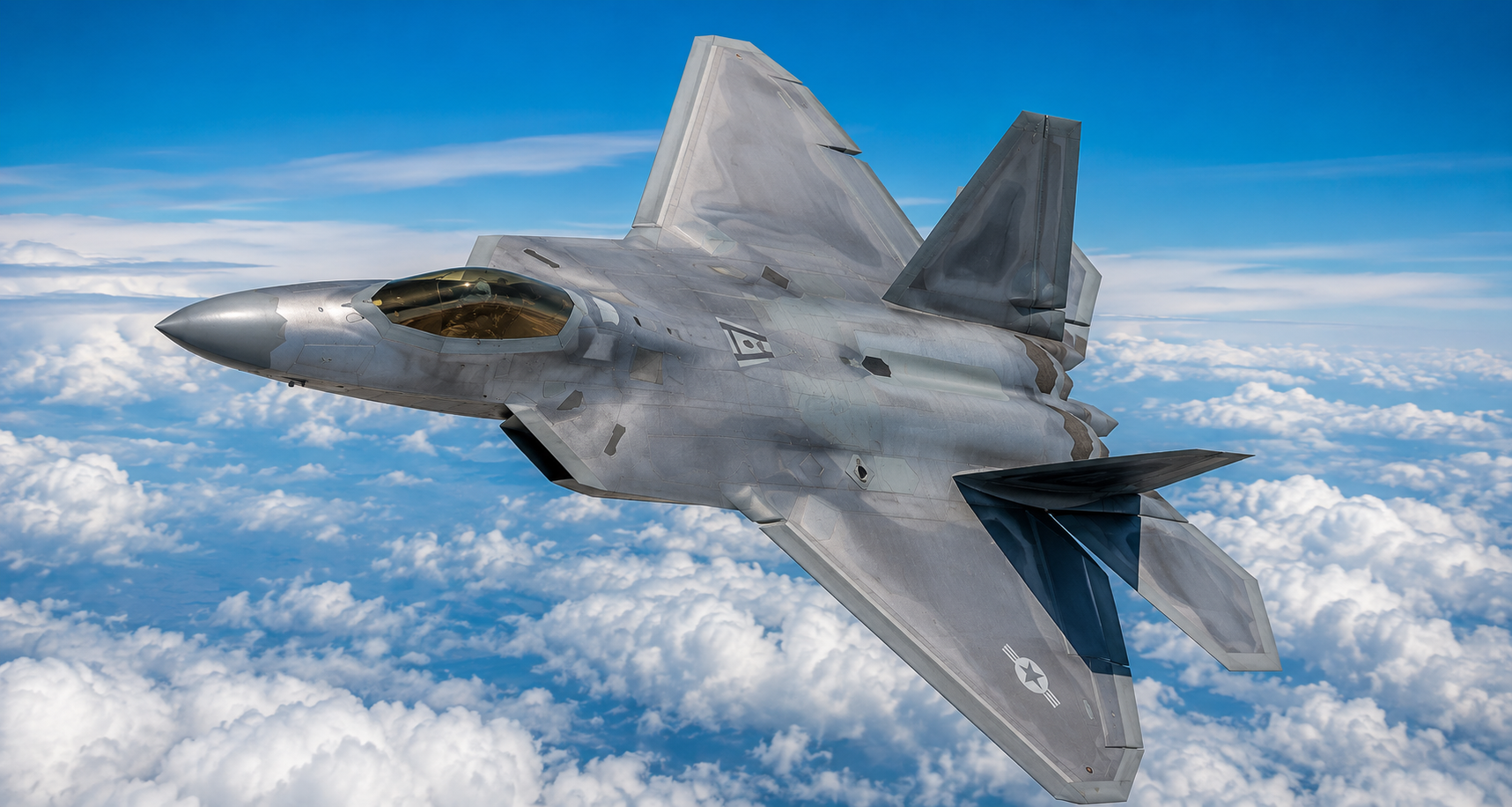
The Lockheed Martin F-22 Raptor is a fifth-generation air superiority fighter operated exclusively by the United States Air Force. Designed as the successor to the F-15 Eagle, the F-22 combines all-aspect stealth, supercruise capability, thrust vectoring, and advanced sensor fusion — making it, by most independent assessments, the most capable dedicated air superiority fighter in operational service worldwide.
Development began under the Advanced Tactical Fighter (ATF) programme in the 1980s. The prototype YF-22 first flew in 1990, and the production F-22A entered service in December 2005. A total of 187 aircraft were produced before production ended in 2011, leaving the USAF with approximately 123 combat-coded Block 35 aircraft.
The F-22 has never been offered for export — it remains the only major US fighter aircraft subject to a Congressional ban on foreign military sales, a restriction that has driven US allies toward the F-35 Lightning II as their primary fifth-generation platform.
F-22 Raptor Specifications
All figures represent verified unclassified performance data. Classified parameters are labelled as estimated.
F-22 Raptor History & Development
Advanced Tactical Fighter Programme
The F-22 originated from the USAF Advanced Tactical Fighter (ATF) programme, launched in 1981 to develop a successor to the F-15 Eagle. Requirements called for a combination of stealth, supersonic cruise, extreme maneuverability, and advanced avionics that had never been achieved simultaneously in a production aircraft.
Two competing teams — Lockheed/Boeing/General Dynamics with the YF-22 and Northrop/McDonnell Douglas with the YF-23 — flew demonstrator aircraft in 1990. The USAF selected the YF-22 in April 1991. The production F-22A underwent substantial redesign from the demonstrator, with significant changes to reduce radar cross-section and improve structural integrity.
The 187-Aircraft Production Decision
The original USAF requirement was for 750 aircraft, progressively reduced to 648, then 339, and finally capped at 187 by the 2009 National Defense Authorization Act. Secretary of Defense Robert Gates justified the decision on cost grounds — the F-22 cost approximately $143 million per aircraft — and the perceived absence of a peer air combat threat at the time.
The decision is now widely regarded as a strategic miscalculation. With China operating the J-20 and Russia deploying the Su-57, the USAF faces near-peer air superiority threats with fewer than 200 of its most capable platform. The Congressional export ban, which prevented the international sales that reduced F-35 unit costs, compounded the problem by making the small production run uneconomical to restart.
Operational Service
The F-22 achieved Initial Operational Capability at Langley AFB in December 2005. Its combat debut came in September 2014 during Operation Inherent Resolve over Syria — striking ground targets, a mission profile its designers had not prioritised. As of 2025, the F-22 undergoes the Block 35 upgrade programme, improving avionics, weapons carriage, and MADL datalink compatibility with the F-35.
F-22 Raptor Stealth Technology
The F-22's low-observable design is comprehensive rather than additive — unlike fourth-generation aircraft retrofitted with radar-absorbent coatings, the F-22 was designed around stealth requirements from the outset. This distinction enables all-aspect rather than frontal-aspect RCS reduction.
Airframe Shaping
External surfaces are angled to deflect radar energy away from the transmitter. The planform uses parallel leading and trailing edges on both wings and tail surfaces, concentrating residual radar return into narrow angular sectors. Every external surface aligns to a minimal set of carefully calculated angles.
Radar Absorbent Materials
Advanced radar-absorbent materials are incorporated throughout the airframe, including composite structures and specialised broadband coatings. The F-22's RAM requires less maintenance than earlier stealth aircraft while providing superior performance across multiple radar frequency bands.
Internal Weapons Carriage
All primary weapons are stored in three internal bays — one main ventral bay and two side bays. This eliminates the radar return from external pylons and weapons, which can increase RCS by an order of magnitude. Bay doors open only briefly during weapon release.
Estimated Radar Cross Section
The F-22's RCS is classified but is commonly estimated at approximately 0.0001 m² in open-source literature — roughly equivalent to a metal marble. This represents approximately four orders of magnitude reduction compared to the F-15 Eagle at around 5 m².
F-22 Raptor Propulsion & Supercruise
The F-22 is powered by two Pratt & Whitney F119-PW-100 low-bypass turbofan engines — producing approximately 35,000 lbf each with afterburner and 26,000 lbf in dry power. The F119 was the first production fighter engine designed from the outset to enable supercruise.
Supercruise at Mach 1.82
The F-22 can sustain approximately Mach 1.82 without afterburner engagement. Operational benefits include extended combat radius at supersonic speed, reduced infrared signature compared to afterburner flight, and forcing adversaries into disadvantaged geometry during beyond-visual-range engagements.
Three-Dimensional Thrust Vectoring
The F119 incorporates axisymmetric thrust vectoring nozzles deflecting ±20° in pitch. This enables controlled post-stall manoeuvres at angles of attack beyond conventional aerodynamic limits, giving the F-22 extreme agility at low speeds in within-visual-range combat scenarios.
F-22 Raptor vs F-35 Lightning II
The F-22 and F-35 are designed for different primary missions. The F-22 is a dedicated air superiority fighter; the F-35 is a multirole strike platform. They are complementary, not competing.
The F-22 is the superior air-to-air platform — faster, higher, with supercruise and thrust vectoring. The F-35 offers better sensor fusion, greater combat radius, multirole flexibility, and access to allied aircraft networks. In doctrine: F-22s clear airspace, F-35s exploit it.