F-35
Lightning II
Lockheed Martin · USA / Multi-Nation Programme · Service Entry 2015
F-35 Lightning II Overview
The Lockheed Martin F-35 Lightning II is a fifth-generation multirole stealth fighter aircraft and the world's most widely operated fifth-generation combat aircraft. Developed under the Joint Strike Fighter (JSF) programme, the F-35 was designed to replace ageing fleets of F-16s, F/A-18s, AV-8B Harriers, and Tornado GR4s across the US military and allied air forces simultaneously — a single common platform serving multiple nations and services.
The F-35 incorporates all-aspect stealth, advanced sensor fusion integrating data from AESA radar, distributed aperture system, and electronic warfare suites into a single coherent tactical picture, and the most sophisticated avionics suite of any production fighter aircraft. Its AN/APG-81 AESA radar and AN/AAQ-37 Distributed Aperture System (DAS) give the pilot 360-degree situational awareness unprecedented in a single-seat fighter.
Three variants serve distinct operational roles: the F-35A for conventional air forces, the F-35B for short take-off and vertical landing operations, and the F-35C for carrier-based naval aviation. As of 2025, over 1,000 F-35s have been delivered across more than 20 operator nations.
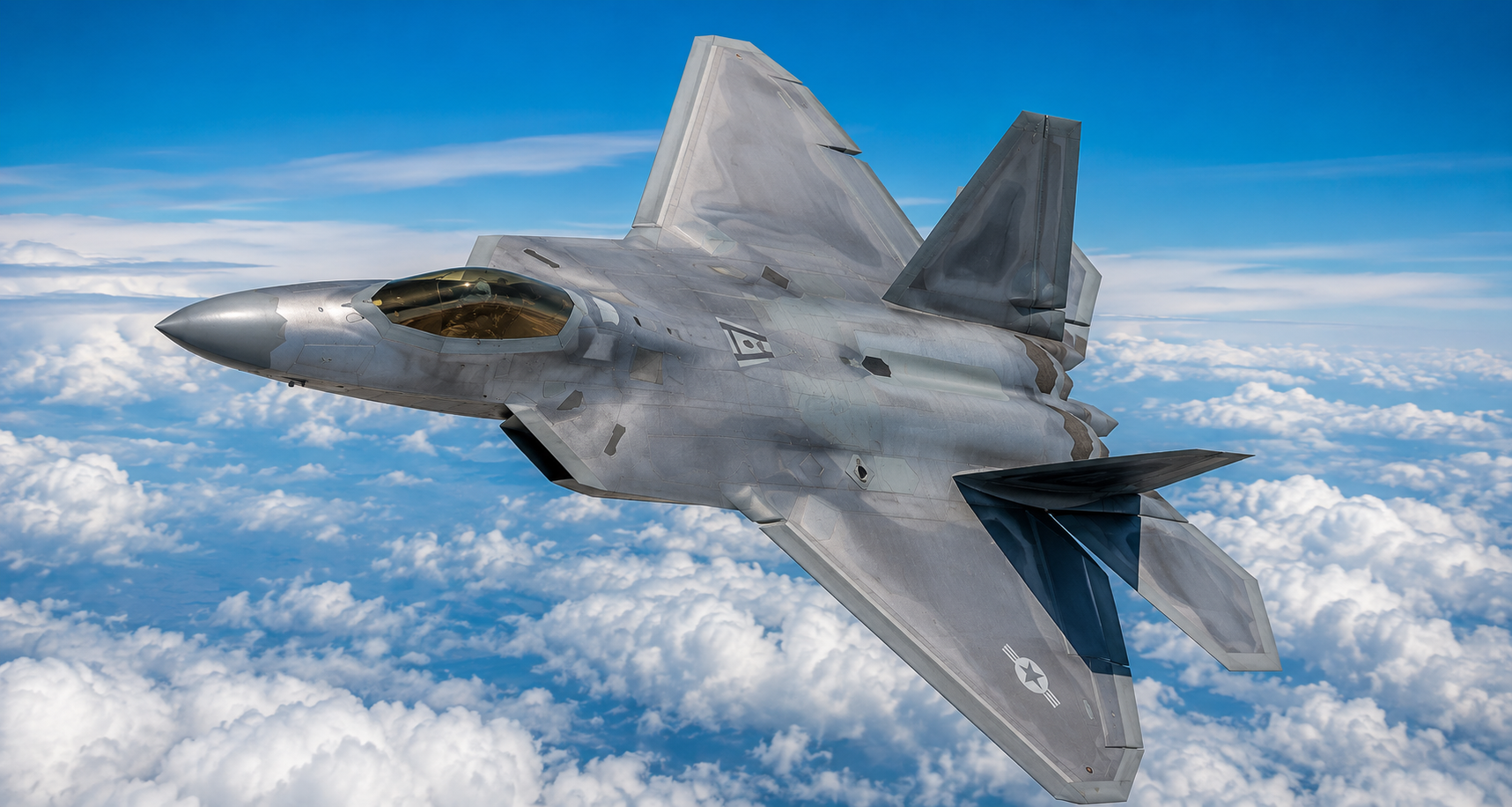
F-35 Variants — A, B & C
The three F-35 variants share approximately 80% airframe commonality but are distinctly different aircraft optimised for their respective operational environments. Each variant serves a different branch of the US military and has been adopted by different allied nations.
The standard variant for conventional air force operations. The F-35A is the lightest, most agile, and least expensive of the three variants. It is the only variant with an internal 25mm cannon.
The STOVL variant for amphibious assault ships and austere airfields. A shaft-driven lift fan replaces the internal gun and some fuel capacity. Operated by USMC, UK Royal Air Force and Royal Navy, and others.
The carrier variant for the US Navy with larger wings for lower approach speeds, reinforced landing gear, and a tailhook for arrested recovery. Larger internal fuel capacity than the F-35A and the longest combat radius of all three variants.
F-35 Lightning II Specifications
Specifications below refer to the F-35A unless otherwise stated. All figures represent verified unclassified data.
F-35 Lightning II History & Development
Joint Strike Fighter Programme
The F-35 emerged from the US Joint Strike Fighter (JSF) competition, launched in the early 1990s to develop a common affordable stealth fighter to replace multiple ageing platforms across the US military and allied nations. The competition was won by Lockheed Martin's X-35 concept over Boeing's X-32 in October 2001, and the programme was formally designated the F-35 Lightning II.
The JSF programme was unprecedented in scope — a single aircraft family designed to satisfy the requirements of the USAF, US Navy, USMC, and multiple partner nations simultaneously. This drove design compromises, most notably the requirement for the F-35B STOVL variant, which influenced the overall fuselage cross-section and constrained performance relative to a pure air superiority design.
Development Challenges
The F-35 programme experienced significant cost growth and schedule delays during development. By 2012, the programme cost had grown to an estimated $395 billion — making it the most expensive weapons programme in history. Concurrency between production and development, software complexity, and the challenge of developing three variants simultaneously contributed to these overruns.
The F135 engine — the most powerful single engine ever fitted to a production fighter — also required extensive development work. The F-35B's shaft-driven lift fan system, designed by Rolls-Royce, required novel engineering solutions to integrate into the existing fuselage design.
Service Entry and Block Upgrades
The USMC declared F-35B Initial Operational Capability in July 2015, followed by the USAF F-35A in August 2016 and the USN F-35C in February 2019. The aircraft has been delivered to the UK, Australia, Netherlands, Norway, Italy, Japan, South Korea, Israel, Belgium, Denmark, Singapore, and Poland among others.
The Block 4 upgrade programme — currently in delivery — substantially expands weapons integration, sensor capability, and electronic warfare performance across all three variants. Block 4 enables integration of new weapons including the UK's Meteor beyond-visual-range missile and SPEAR 3 cruise missile.
F-35 Lightning II Stealth & Sensor Fusion
Low Observable Design
The F-35 incorporates all-aspect stealth through airframe shaping, radar-absorbent materials, and internal weapons carriage. Its estimated radar cross section is approximately 0.001 m² — significantly lower than any fourth-generation fighter, though higher than the F-22 Raptor's estimated 0.0001 m².
The F-35's stealth is designed for the frequency bands used by modern surface-to-air missile systems and airborne intercept radars. The airframe uses carefully aligned edge treatments, internal weapons bays, and embedded antennas to minimise RCS across relevant threat frequencies.
Sensor Fusion — The F-35's Defining Advantage
The F-35's most revolutionary capability is not its stealth but its sensor fusion. The aircraft integrates data from its AESA radar, distributed aperture system, electro-optical targeting system, electronic warfare suite, and datalink network into a single fused tactical picture presented to the pilot. This eliminates the cognitive burden of monitoring multiple separate sensors and enables faster, more accurate decision-making.
The AN/AAQ-37 DAS provides full-spherical infrared situational awareness — the pilot can literally see through the aircraft floor via the helmet display. This capability is unmatched in any other production combat aircraft.
Network Capability
Unlike the F-22, which uses a proprietary Intra-Flight Data Link limiting network sharing to F-22 formations, the F-35 supports the Multifunction Advanced Data Link (MADL) for sharing targeting data with other F-35s and can also share data via Link 16 with older fourth-generation aircraft. This network capability amplifies the value of individual F-35s and makes every aircraft in a formation more effective.
F-35 Lightning II Operators
The F-35 is operated by over 20 nations, making it the most widely adopted fifth-generation fighter in history. The following lists confirmed operational and ordered customers as of 2025.
F-35 Lightning II vs F-22 Raptor
The F-35 and F-22 are the world's only operational fifth-generation stealth fighters produced in quantity. They are frequently compared but were designed for fundamentally different primary roles.
The F-22 is the superior dedicated air superiority platform with higher speed, ceiling, and supercruise. The F-35 compensates with longer range, superior sensor fusion, multirole flexibility, and availability to allied nations. Operationally they function as a team — F-22s dominate contested airspace while F-35s leverage their sensor advantage for strike and network coordination.