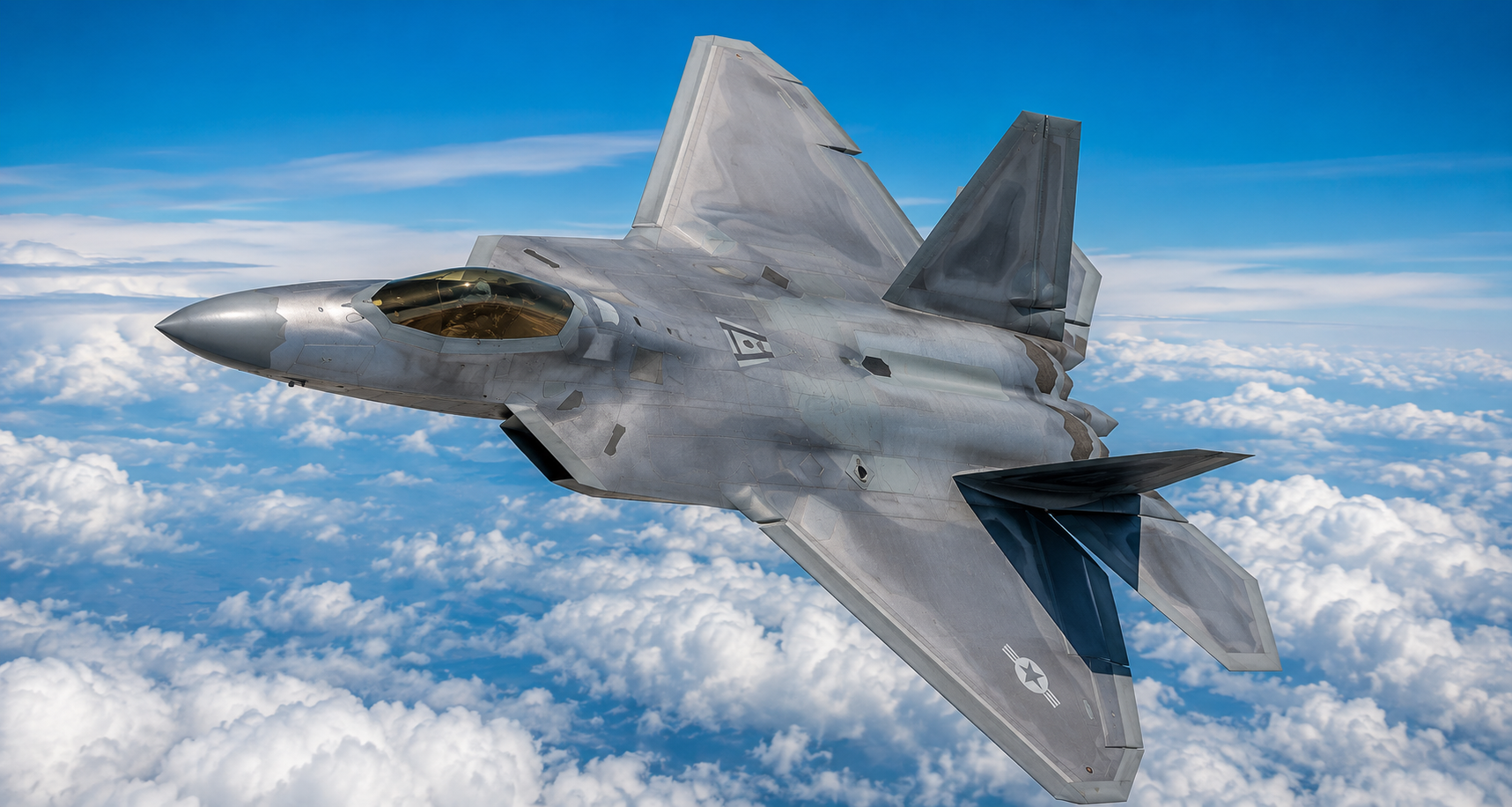
F-22 Raptor vs F-35 Lightning II Overview
The F-22 Raptor vs F-35 Lightning II comparison is the most searched fighter jet matchup on the internet — and for good reason. Both are fifth-generation stealth fighters built by Lockheed Martin, both are operated by the United States Air Force, and both represent the absolute cutting edge of military aviation. Yet they are fundamentally different aircraft designed for fundamentally different missions.
Understanding the difference between the F-22 and F-35 requires understanding what each aircraft was built to do. The F-22 was designed to dominate other aircraft — to be the most capable air superiority fighter ever built, invisible to radar, faster than any adversary, and capable of killing enemy jets before they know the F-22 is there. The F-35 was designed to do everything else — a multirole platform replacing multiple ageing aircraft across the US military and allied air forces, capable of strike, electronic warfare, reconnaissance, and close air support, not just air-to-air combat.
F-22 vs F-35 Full Specification Comparison
F-22 vs F-35 Speed Comparison
On speed, the F-22 Raptor wins decisively. The F-22 has a maximum speed of Mach 2.25 at altitude — approximately 1,500 mph — compared to the F-35's Mach 1.6. That is a difference of approximately 560 mph at maximum performance, or roughly 40% faster.
More significant than maximum speed is the F-22's supercruise capability. The F-22 can sustain approximately Mach 1.82 without engaging its afterburners, meaning it can cruise supersonically while conserving fuel and reducing its infrared signature. The F-35 has no supercruise capability — it requires afterburner to go supersonic at all, burning fuel at a dramatically higher rate and creating a much larger infrared signature that heat-seeking missiles can track.
In practical terms, the F-22's speed advantage means:
- Greater ability to dictate the terms of an engagement — approaching, disengaging, or repositioning faster than any adversary
- Extended supersonic patrol time without depleting fuel reserves
- Higher energy state entering any engagement, providing more options in manoeuvring combat
- Reduced exposure time over threat zones through higher cruise speed
F-22 vs F-35 Stealth Comparison — Which Is More Stealthy?
Both the F-22 and F-35 are fifth-generation Very Low Observable (VLO) aircraft — far stealthier than any fourth-generation fighter. However, the F-22 has a lower radar cross-section, particularly in the X-band frequencies used by airborne intercept radars.
The F-22's estimated RCS of approximately 0.0001 m² — often described as the size of a metal marble — is approximately ten times lower than the F-35's estimated 0.001 m². This difference reflects the F-22's more aggressive stealth shaping, designed specifically for penetrating the most heavily defended airspace against advanced Soviet-era and peer adversary air defence systems.
The F-35's stealth, while slightly less extreme than the F-22's in X-band, was designed with a different threat environment in mind — penetrating surface-to-air missile systems for strike missions rather than exclusively winning air-to-air engagements. Some analyses suggest the F-35 may have lower RCS in certain lower-frequency bands used by long-range surveillance radars, though this is not confirmed by open sources.
Verdict: F-22 is stealthier for air-to-air missions. Both are extremely stealthy by any practical measure.
Can the F-35 Beat the F-22 in a Dogfight?
This is one of the most searched questions in military aviation — and the honest answer is: in a traditional within-visual-range dogfight, the F-22 Raptor wins. But the full picture is more nuanced.
The F-22 was specifically engineered for air superiority combat. Its thrust-vectoring nozzles allow it to perform post-stall manoeuvres at angles of attack the F-35 simply cannot match. Its higher thrust-to-weight ratio, greater speed, and superior climb rate give it an energy advantage in any manoeuvring engagement. Former USAF Chief of Staff General Mark Welsh said it plainly: "The F-35 was never designed to be the next dogfighting machine."
However, the F-35 is not defenceless in close combat. In Red Flag exercises, F-35 pilots have reported using the aircraft's superior sensor fusion and 360-degree situational awareness to negate some of the F-22's kinematic advantages. The F-35 pilot sees the entire battlespace through the helmet-mounted Distributed Aperture System — including behind the aircraft — which is a genuine tactical advantage even when the aircraft itself is slower and less agile.
Note: In realistic operational scenarios, F-22s and F-35s are allied aircraft and would never be in combat against each other. This analysis is purely academic.
What Do Pilots Actually Say?
Multiple F-35 pilots who have flown in exercises against F-22s have noted that the F-22's kinematic superiority is real and significant in close combat. However, they have also noted that the F-35's sensor suite frequently allowed them to detect and target the F-22 before entering the merge — suggesting the most dangerous F-35 capability is not in the dogfight itself, but in the beyond-visual-range engagement that precedes it.
General David Deptula, former USAF Deputy Chief of Staff for ISR, summarised it well: "Asking whether the F-35 can beat the F-22 in a dogfight is like asking whether a Formula One car can beat a pickup truck in off-road racing. The question misses the point of the design."
F-22 vs F-35 Cost Comparison
The F-35 is significantly less expensive than the F-22 — approximately $82 million per F-35A versus $143 million per F-22 in flyaway cost. This 42% cost advantage is substantial and has major strategic implications.
The F-22's higher cost stems from several factors: its more powerful and complex twin-engine design, the small production run of only 187 aircraft (which spreads development costs across fewer units), and the Congressional export ban which prevented international sales that could have reduced per-unit costs. Had the F-22 been produced at the originally planned quantity of 750 aircraft, the per-unit cost would have been dramatically lower.
The F-35's lower cost — still extremely high by historical standards — is enabled by a production run expected to exceed 3,000 aircraft across 20+ operator nations. International partner contributions help defray development costs, and the economies of scale from this volume reduce per-unit manufacturing costs significantly.
In lifecycle cost terms, the F-35 also benefits from a more modern design with lower maintenance requirements than the F-22, whose stealth coatings have historically been labour-intensive to maintain.
F-22 vs F-35 Final Verdict
The F-22 vs F-35 debate misses the fundamental point that these aircraft were never designed to compete with each other — they were designed to complement each other. The US Air Force's operational concept deliberately pairs them: F-22s clear and control contested airspace; F-35s exploit that airspace for strike, surveillance, and electronic warfare missions.
If you need one aircraft to win a knife fight against enemy fighters in contested airspace — choose the F-22. If you need one aircraft to replace an entire air force's worth of legacy jets and do everything from strike to ISR to electronic warfare — choose the F-35. The US chose both, and that is entirely the point.
F-22 vs F-35 FAQ
Related Fighter Jet Comparisons
vs F-16 Falcon
Heavy air superiority vs lightweight multirole — the classic 4th generation pairing explained.
View Comparisonvs Dassault Rafale
Europe's two premier 4.5th-generation fighters — speed and payload versus flexibility and exports.
View Comparisonvs F-22 Raptor
Russia's fifth-generation answer to America's premier air superiority fighter compared head-to-head.
View Comparison