Fighter Jet
Generations
A complete technical guide to all six fighter jet generations — from the subsonic jets of the late 1940s to the stealth-optimised fifth-generation platforms and next-generation programmes currently in development.
Fighter Jet Generation Overview
First Generation
Fighter Jets
Late World War II — Korean War Era
First-generation fighter jets represent the transition from piston-engined propeller aircraft to jet propulsion. These aircraft were primarily subsonic, armed with cannons and early unguided rockets, and relied on the pilot's visual identification of targets — a doctrine inherited directly from World War II aerial combat.
The defining conflict for first-generation jets was the Korean War (1950–1953), which saw the F-86 Sabre engage the Soviet-built MiG-15 in the first large-scale jet-versus-jet air combat. Early jet engines were unreliable and fuel-hungry, limiting range significantly compared to piston-engined predecessors.
- Jet propulsion — turbojet engines replacing piston powerplants, enabling higher speeds and altitudes
- Swept wings — introduced to delay compressibility effects at high subsonic speed
- Gun armament — 20mm cannons and 12.7mm machine guns as primary weapons
- Basic radar ranging — early gunsight radar for range estimation only
Fourth Generation
Fighter Jets
Post-Vietnam Reform Era
Fourth-generation fighter jets emerged directly from the lessons of the Vietnam War, where overcomplicated aircraft and over-reliance on missiles at the expense of guns and dogfighting capability resulted in unexpectedly poor air-to-air performance. The fourth generation prioritised maneuverability, pilot situational awareness, and reliability.
Key innovations included fly-by-wire flight control systems, pulse-Doppler radar capable of detecting targets in ground clutter, and long-range beyond-visual-range missiles. The F-15 Eagle, F-16 Fighting Falcon, MiG-29, and Su-27 Flanker defined the fourth generation and remain in widespread service today.
- Fly-by-wire controls — electronic flight control replacing mechanical linkages, enabling relaxed static stability for enhanced agility
- Pulse-Doppler radar — look-down/shoot-down capability against low-flying targets previously masked by ground returns
- BVR missiles — beyond-visual-range engagements using AIM-7 Sparrow and AIM-54 Phoenix
- HOTAS cockpits — Hands-On Throttle and Stick allowing full weapons employment without removing hands from controls
| Parameter | F-15 Eagle | F-16 Falcon | MiG-29 | Su-27 |
|---|---|---|---|---|
| Max Speed | Mach 2.5 | Mach 2.0 | Mach 2.25 | Mach 2.35 |
| Service Entry | 1976 | 1978 | 1983 | 1985 |
| Role | Air Sup. | Multirole | Air Sup. | Air Sup. |
| Engines | Twin | Single | Twin | Twin |
Fifth Generation
Fighter Jets
Stealth & Sensor Fusion Era
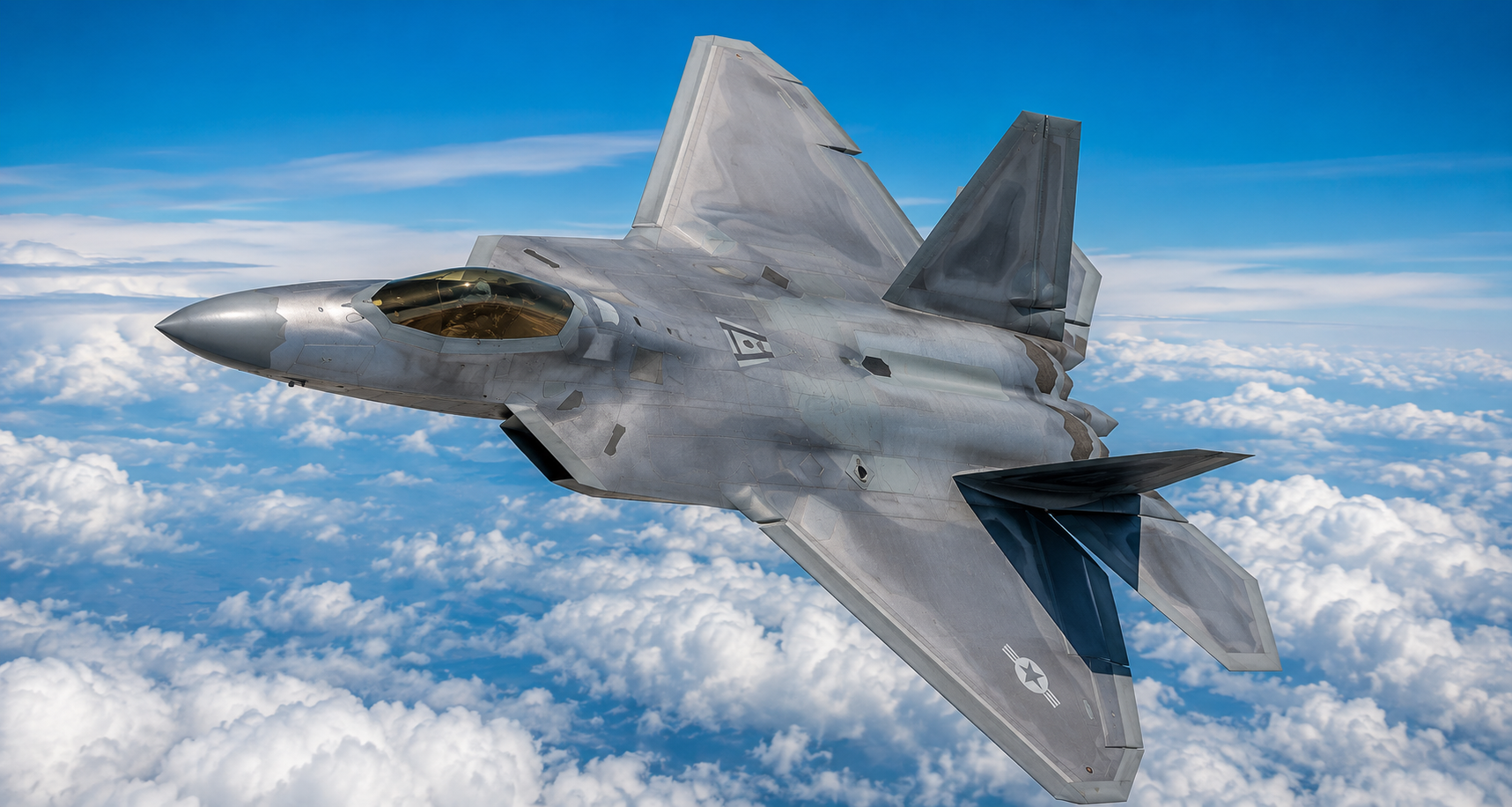
Fifth-generation fighter jets represent the most significant leap in fighter aircraft capability since the introduction of jet propulsion. The defining characteristics are all-aspect stealth, advanced sensor fusion integrating data from multiple onboard and offboard sensors into a single coherent tactical picture, and internal weapons carriage to maintain low observable profiles throughout a mission.
The F-22 Raptor, which entered service with the USAF in 2005, remains the world's most capable air superiority fighter. The F-35 Lightning II is the most widely operated fifth-generation fighter with over 20 operator nations. China's J-20 and Russia's Su-57 represent competing fifth-generation platforms with differing capability assessments.
- All-aspect stealth — airframe shaping, radar-absorbent materials, and internal weapons bays reduce radar cross-section across all threat frequencies
- Sensor fusion — AESA radar, IRST, electronic warfare systems, and datalink information combined into a single fused picture
- Supercruise — sustained supersonic flight in dry power without afterburner engagement (F-22: Mach 1.82)
- Network-centric warfare — high-bandwidth secure datalinks enabling real-time sharing of sensor data across the battlespace
- Thrust vectoring — three-dimensional nozzle control for post-stall maneuverability (F-22, Su-57)
| Parameter | F-22 Raptor | F-35A | Su-57 | J-20 |
|---|---|---|---|---|
| Max Speed | Mach 2.25 | Mach 1.6 | Mach 2.0 | Mach 2.0+ |
| Ceiling | 65,000 ft | 50,000 ft | 66,000 ft | 66,000 ft |
| Supercruise | Yes | No | Yes | Unconfirmed |
| Entry | 2005 | 2015 | 2020 | 2017 |
Sixth Generation
Fighter Jets
Next-Generation Air Dominance — 2030s Onwards
Sixth-generation fighter jet programmes are currently in development across the United States, Europe, and Asia. These programmes aim to deliver capabilities significantly beyond current fifth-generation platforms, with a focus on enhanced stealth, artificial intelligence integration, directed energy weapons, and optionally-manned operation.
- AI-assisted decision making — onboard artificial intelligence supporting sensor fusion, threat prioritisation, and weapon employment
- Optionally manned — capability to operate with or without a human pilot in the cockpit
- Directed energy weapons — high-energy laser systems for both offensive engagement and defensive missile defeat
- Loyal wingman integration — command and control of unmanned combat air vehicles operating collaboratively