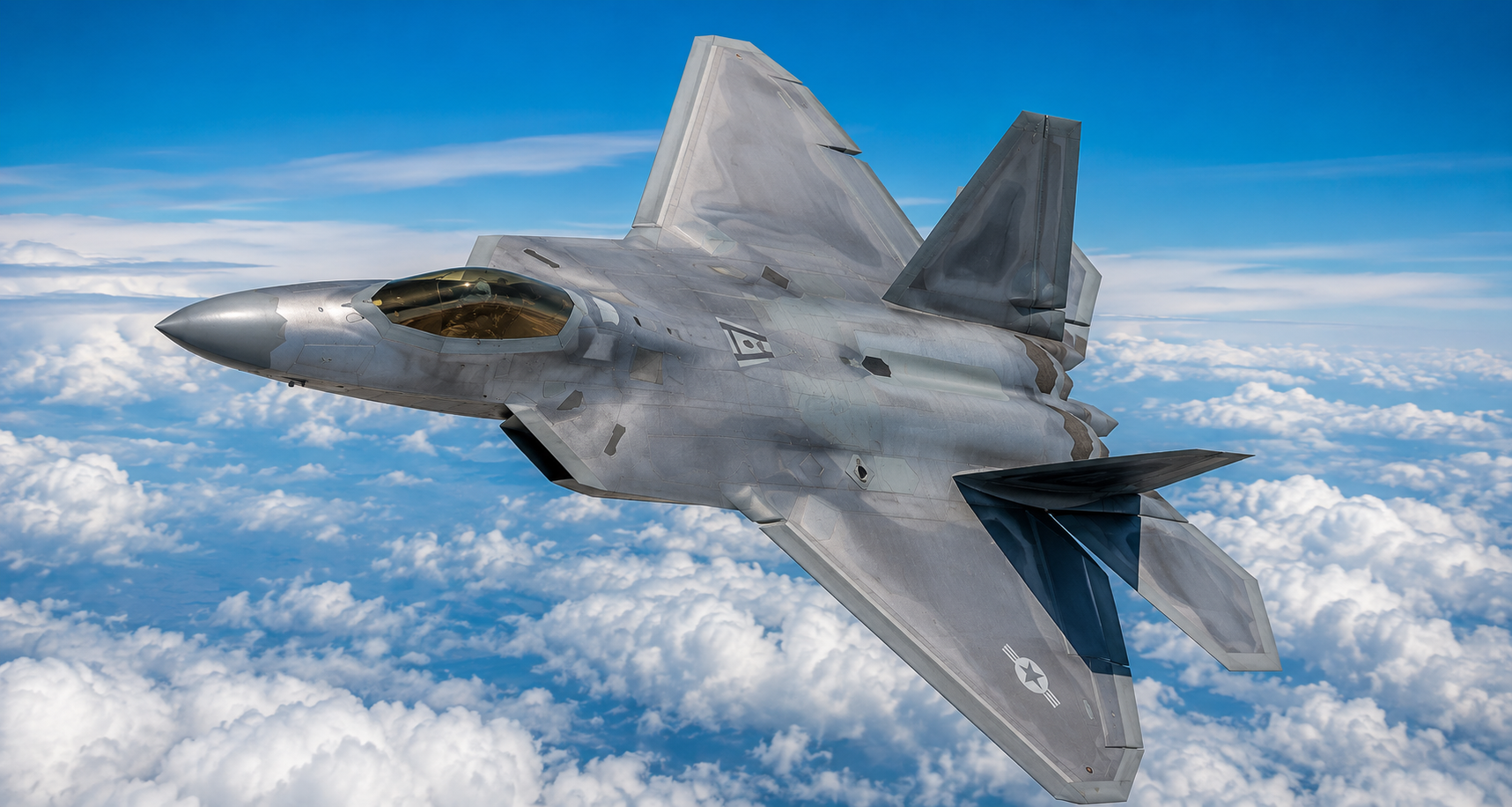
Eagle
Falcon
F-15 vs F-16 Fighter Jet — Overview
The F-15 Eagle and F-16 Fighting Falcon are America's two most iconic Cold War fighter jets — both born from the same US Air Force programme, yet designed for fundamentally different missions. Understanding the F-15 vs F-16 comparison requires understanding why the US Air Force needed two aircraft in the first place.
In the early 1970s, following the painful lessons of Vietnam — where US fighters frequently lost close-range dogfights against lighter, more agile Soviet-designed aircraft — the USAF launched two parallel programmes. The F-X programme produced the F-15 Eagle: a large, expensive, supremely capable dedicated air superiority fighter jet designed to ensure air dominance at any cost. The Lightweight Fighter (LWF) programme produced the F-16: a smaller, cheaper, highly agile multirole fighter jet that could be bought in much larger numbers.
The result was the Hi-Lo mix — a deliberate strategy of pairing a small number of high-capability F-15s with a large force of affordable F-16s. Together they have formed the backbone of US and allied air power for over four decades, and both remain in active production and service today.
Key distinction: The F-15 Eagle was built to win air-to-air combat against any enemy aircraft at any range. The F-16 Fighting Falcon was built to be affordable enough to replace thousands of ageing fighters worldwide while being agile enough to hold its own in a dogfight. They are complementary fighter jets — not direct competitors.
F-15 vs F-16 Fighter Jet Full Specifications
| Metric | F-15C Eagle | F-16C Block 50 |
|---|---|---|
| Top Speed | Mach 2.5+ F-15 ✓ | Mach 2.0 |
| Combat Radius | 685 nm F-15 ✓ | 575 nm |
| Service Ceiling | 65,000 ft F-15 ✓ | 50,000 ft |
| T/W Ratio | 1.07 | 1.10 F-16 ✓ |
| Engines | Twin F100-PW-220 F-15 ✓ | Single F110-GE-129 |
| Max Payload | 23,000 lb F-15 ✓ | 17,000 lb |
| Hardpoints | 9 stations F-15 ✓ | 9 stations Tie |
| Empty Weight | 28,600 lb | 19,700 lb F-16 lighter |
| Inst. Turn Rate | ~28°/sec | >26°/sec Similar |
| BVR Capability | Superior — APG-63/70 F-15 ✓ | Good — APG-68 |
| Air-to-Ground | Good (F-15E Strike Eagle) | Excellent — primary role F-16 ✓ |
| Unit Cost | ~$108M | ~$32M (legacy) F-16 ✓ |
| Total Built | ~1,200 | 4,600+ F-16 ✓ |
| Air-to-Air Record | 104–0 F-15 ✓ | 76+ kills / some losses |
F-15 vs F-16 Fighter Jet Top Speed
The F-15 Eagle is significantly faster than the F-16 Fighting Falcon. The F-15C's maximum top speed exceeds Mach 2.5 — some sources cite Mach 2.5+, with the aircraft structurally limited rather than engine-limited, meaning actual maximum speed may be higher still. The F-16C tops out at Mach 2.0 with its single engine.
The F-15's twin engines produce a combined thrust of approximately 47,000 lbf with afterburner — giving it both higher top speed and better sustained energy management at high altitude. The F-16's single engine is sufficient for its designed role but cannot match the F-15's raw speed ceiling.
In practical terms the speed gap matters most at high altitude — where the F-15 can disengage from any fight at will, using its superior speed to dictate the terms of engagement. This is one of the F-15's defining tactical advantages.
F-15 vs F-16 Fighter Jet — Dogfight Analysis
The dogfight comparison between these two fighter jets is more nuanced than the speed numbers suggest. In a within-visual-range (WVR) turning engagement, the gap between the F-15 and F-16 narrows considerably.
Where the F-16 Has the Edge
The F-16 was specifically designed for close-range agility. Its relaxed static stability — the aircraft is aerodynamically unstable and relies entirely on fly-by-wire computers to maintain controlled flight — gives it exceptional instantaneous turn performance. The higher thrust-to-weight ratio of 1.10 versus the F-15's 1.07 means the F-16 can sustain energy in a turning fight more efficiently. At low-to-medium speeds in a phone-booth dogfight, the F-16 is a genuinely dangerous opponent for any aircraft.
Where the F-15 Has the Edge
The F-15's tactical advantage is that a skilled F-15 pilot would not fight the kind of slow, turning close-range engagement where the F-16 is most competitive. The F-15 would use its superior speed, altitude, and radar capability to engage at beyond visual range — firing AIM-120 AMRAAM missiles before the F-16 can close to guns or short-range missile range. The F-15's twin engines also allow it to sustain higher speeds for longer, making energy recovery faster after a manoeuvre.
USAF Aggressor Exercise finding: In Red Flag and similar exercises where F-15s and F-16s have trained against each other, results are mixed and heavily dependent on starting conditions, altitude, and the specific tactics employed. Neither aircraft consistently dominates — pilot skill and situational awareness matter more than the platform difference at close range.
F-15 vs F-16 Fighter Jet Combat Record
F-15 Eagle — 104 Kills, 0 Losses
The F-15 Eagle holds one of the most remarkable combat records in aviation history — 104 confirmed air-to-air kills with zero losses to enemy aircraft. This record spans over four decades of combat from 1979 to the present, in the hands of US, Israeli, Saudi Arabian, and Japanese pilots. The kills include MiG-21s, MiG-23s, MiG-25s, MiG-29s, Su-22s, Mirage F1s, and various other aircraft types. The 104–0 record has never been broken — no F-15 has ever been shot down by an enemy fighter.
F-16 Fighting Falcon — Strong but Mixed Record
The F-16 has accumulated over 76 confirmed air-to-air kills in service — a strong record by any measure. Israeli Air Force F-16s destroyed numerous Syrian aircraft during the Lebanon War of 1982 and subsequent operations. USAF F-16s served in Desert Storm, Allied Force, and Iraqi Freedom. However, F-16s have also suffered losses to enemy aircraft and surface-to-air missiles in combat — unlike the F-15's unblemished air-to-air record.
The combat record comparison is not entirely fair — the F-16 has flown far more combat sorties in contested environments than the F-15, increasing its exposure to losses. The F-15 has largely operated in scenarios where it held overwhelming technological superiority over its opponents.
F-15 vs F-16 Fighter Jet Cost Comparison
Cost is where the F-16 has its most decisive advantage — and the primary reason it has been ordered by over 25 nations while the F-15 has only been exported to 6.
- F-15C unit cost: approximately $108 million (legacy production)
- F-15EX Eagle II unit cost: approximately $87–100 million (current production)
- F-16C Block 50 unit cost: approximately $32 million (legacy production)
- F-16 Block 70/72 unit cost: approximately $64–70 million (current production)
- F-15 cost per flight hour: approximately $41,000–68,000
- F-16 cost per flight hour: approximately $7,900–22,000
For the cost of one F-15, a nation can buy two to three F-16s. Over the life of a fleet, the operating cost difference compounds dramatically. This economic reality is why the F-16 has been the world's most exported fighter jet and why it has equipped air forces from Norway to Pakistan to South Korea.
F-15 vs F-16 Fighter Jet — Which is Better?
Two Different Fighter Jets Built for Two Different Jobs
The F-15 Eagle is the better fighter jet for pure air-to-air combat. Its 104–0 combat record, Mach 2.5+ top speed, superior radar, twin-engine performance, and longer range make it the most dominant air superiority fighter jet ever built. If air-to-air dominance is the only criterion, the F-15 wins without question.
The F-16 Fighting Falcon is the better fighter jet for overall value and multirole flexibility. At two to three times lower cost, the F-16 can be bought in larger numbers, maintained more cheaply, and employed across a far wider range of missions including precision ground attack, SEAD, and close air support. For most air forces that need a capable, affordable modern fighter jet rather than a dedicated air superiority platform, the F-16 is the more rational strategic choice.
The US Air Force made exactly this calculation when it adopted both — pairing high-capability F-15s for air superiority with affordable F-16s for the multirole mission. The two fighter jets are not rivals. They are partners.